
Free webinar recording with captain Sergy
Ocean Adventure Sailing in the Canary IslandsWebinar recording
Watch a week of real sailing between volcanic islands, with captain Sergy’s honest answers to guests’ questions.
Webinar recording
Watch the full webinar
In this free 56-minute webinar, captain Sergy Almer, founder of Elmár Sailing and an RYA & ISSA licensed skipper, explains the Ocean Adventure Sailing week in the Canary Islands. The trip starts and finishes in Tenerife and may stop at La Gomera and La Palma, depending on wind and weather. It takes up to 8 guests, no sailing experience is needed, and an optional ISSA Competent Crew license can be earned on the same week. The recording covers a typical day on board, seasickness and safety, what the price includes, two past guests sharing their experience, and live questions from viewers.
Read the full transcript
Lightly edited transcript of the live webinar, streamed on 7 October 2026. Filler words are removed, and the expired webinar-only price offer is left out.
0:00 Welcome and tonight’s plan
Sergy: All right, restarting. So, I’m very curious: where are you watching from? Please write your city or country in the comments, and in the meantime I’ll prepare the deck with all the slides for you.
Okay, now I’m sharing my screen. Oh, nice, I see so many different locations. Thanks for sharing: France, Austria, Portugal, Spain. I’m also in Spain now, by the way, and our next sailing trip will also be around Spain, around the Balearic Islands. England, amazing. So, let’s start.
This is the plan for tonight’s webinar. We’ll go through how it works, what route we’ll sail on this trip, because this is about the Canary Islands trip, and who you can expect on board. Two people who sailed with us before agreed to talk a little about their experience and let me ask them questions. We can also mention alternative trips, and of course we’ll take your questions in the YouTube comments.
Out of curiosity, can you put a plus in the comments if you’ve sailed before and a minus if you haven’t? I see some of you have sailed already, and some first-timers too. Thanks for sharing.
3:28 About captain Sergy and Elmár Sailing
A little bit of history about me and our company. I’m not from a family of sailors, and I didn’t sail as a child. I spent most of my career in information technology. I fell in love with sailing after trying it for the first time in Turkey with friends, and then I learned in Ireland. That was 10 years ago, and since then I’ve clocked more than 25,000 nautical miles, which would be pretty much once around the Earth. I’m licensed by the Royal Yachting Association and the International Sailing Schools Association.
Our company, Elmár Sailing (by the way, “el mar” simply means “the sea” in Spanish), has existed for eight years, and we’ve had more than 700 guests. An interesting fact: about 80% of guests who come for the first time have never sailed before, and after the trip they keep sailing. So if you’ve never sailed, it’s totally fine. Experience isn’t required, because you can learn during your first trip.
5:23 Why the Canary Islands: true ocean sailing
This Canary Islands week is a little bit special. Compare it to a Mediterranean week: the Mediterranean is very often completely flat, with not enough wind. Sometimes I even hear little complaints that it would be nice to sail more, because we motored quite a lot. I agree: when there’s no wind we use the engine, because we don’t want to stay in one place. But something is missing.
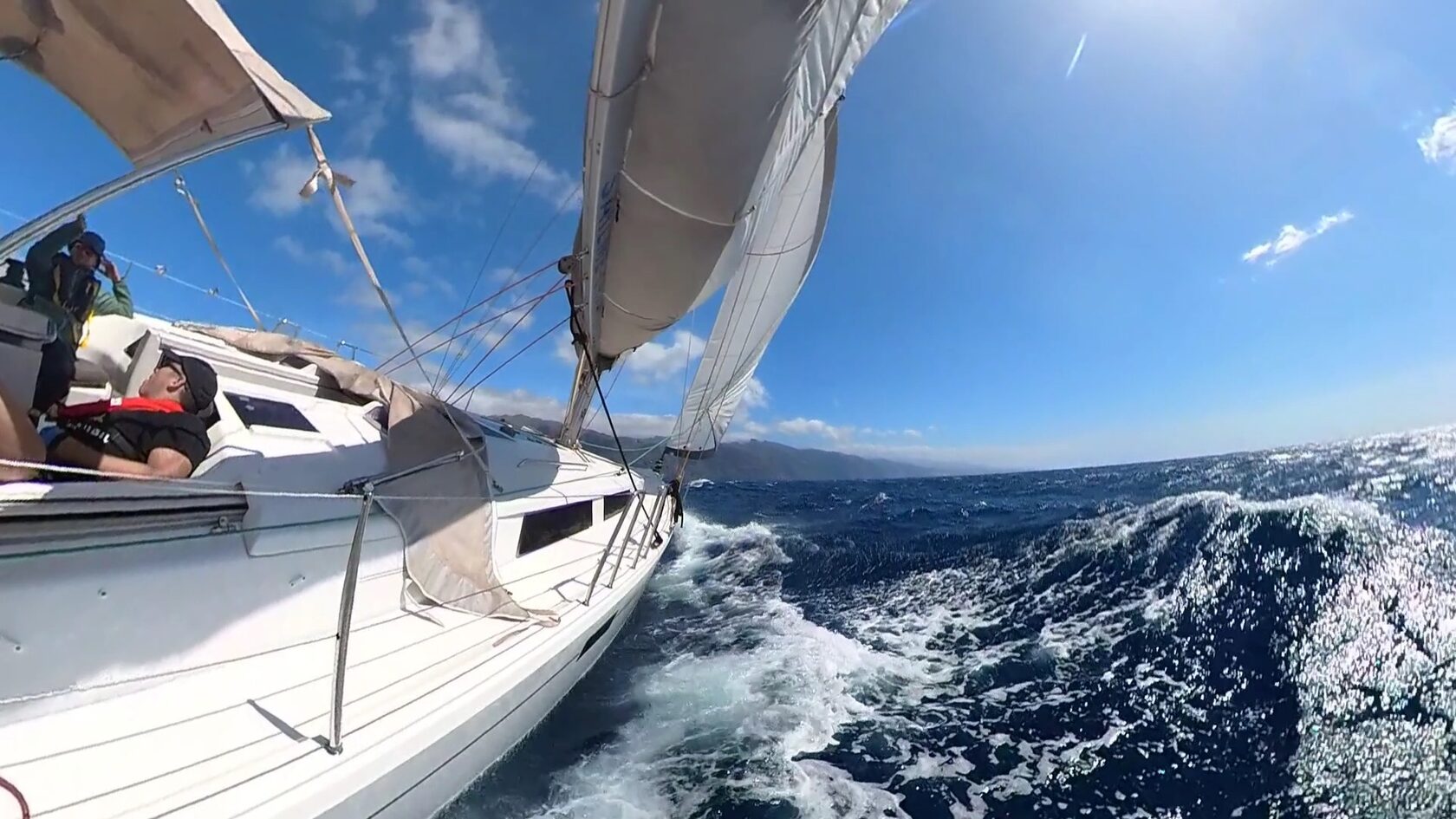
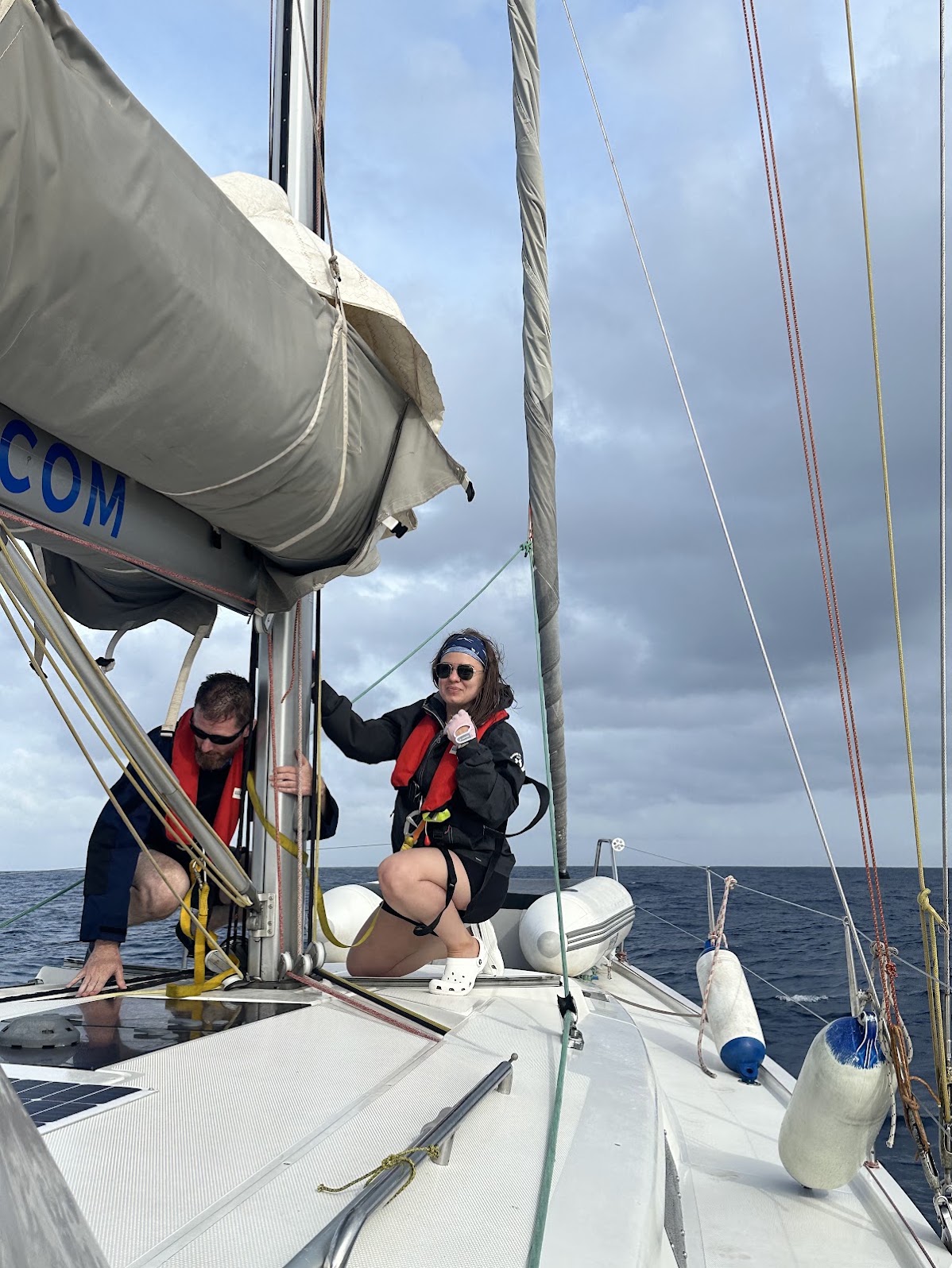
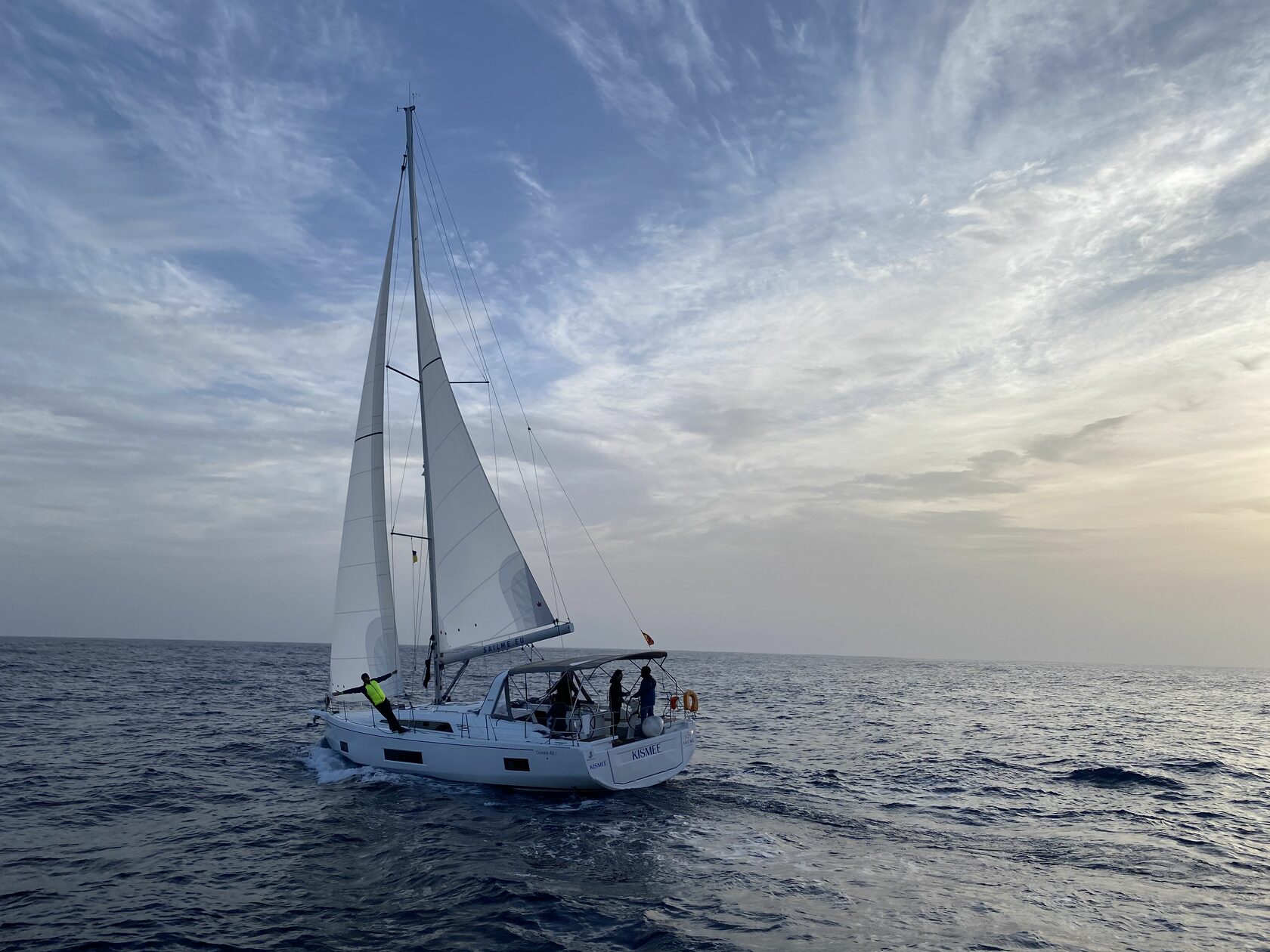
In the Canary Islands this week will be different. It’s all about true sailing, because in the Canaries wind and waves are guaranteed. I always say it’s the next level after the Mediterranean: the weather is more serious, and you’re guaranteed to catch a lot of wind and sail a lot instead of motoring. That’s what a lot of us miss in the middle of summer in the Mediterranean. This week can be full of adrenaline: you feel the yacht heeling and you push your limits a little. At the same time it’s safe, with a warm climate and warm water, so you don’t need special equipment. Very often you can still wear your summer clothes. You may need a jacket one day, and the next day you’ll easily be in a T-shirt and shorts.
7:44 How it works: living on board, exploring ashore, cooking together
The main idea is that we live and travel on the yacht. As soon as you bring your backpack or a small suitcase, you unpack it, and from then on you don’t need to change hotels or drive around, because our home travels with us. We don’t sleep at sea, so it’s quite comfortable. We sail during the day, and at night we’re either in a port, which we call a marina, or at anchor in a beautiful bay.
It’s not about sitting on board all the time. About half of the time we explore the land. We go hiking (it’s optional, but it’s nice), and sometimes we rent quads, bicycles or cars, or just walk, and explore what the Canary Islands can give us: volcanic sand and unique places, many of them not accessible from land because they’re guarded by cliffs. When we arrive by sailing yacht, they’re all for us.
Next question: how do we eat? We follow the classic sailing team setup. You can only join as crew of the yacht; there are no passengers. Part of the crew experience is bringing food from the market or supermarket and cooking on board together, and of course sometimes we eat out in a restaurant together. It’s about 50/50, and there’s no hired chef on this trip. I can tell you it’s much better than cooking at home. I hate cooking at home, but on board I’m happy to do it, because as crew you always have time for it. And it becomes a culture exchange, because people come from all different countries. We eat at one of the two tables on the yacht.
10:52 The route: Tenerife, La Gomera and La Palma
The Canary Islands adventure starts and finishes on Tenerife. This island is very special to me: I’ve explored it a lot, not only sailing around but also on land. It has a big sleeping volcano in the middle, Teide, almost 4,000 metres high: the highest point in the Atlantic and the highest point in Spain. The beauty of Tenerife is astonishing. Whether you sail or drive around it, you feel the climate zone change every few hours: it can be dry like a desert, or wet and humid with forest. This picture was taken when we hiked in the north of Tenerife, around Garachico. It’s more humid there and a few degrees colder, while the southwest of the island can be really hot, sometimes up to 30° even in December.
Then we go to La Gomera, a beautiful small island and one of the islands without an international airport, so it’s less touristy. You arrive by a tiny local plane, by ferry or by sailing. On La Gomera you can explore a lot of nature, like the evergreen forest. These are our pictures from one of the bays in La Gomera. By the way, when we caught this sea star, we immediately released it, because it shouldn’t be left dry.
If the weather allows, we can go to La Palma. In Spanish they call it La Isla Bonita, the beautiful island, because it’s so green, with a lot of forest, vegetation and waterfalls. It feels like a jungle, and it also has a sleeping volcano. This picture is from three or four years ago: the volcano erupted, which you probably remember because it was in the news everywhere. When the eruption finished, we had a sailing trip around there, so we came close and actually stepped on the lava. As you see, it was still steaming and warm, and we could walk on that fresh lava and see the power of nature. La Palma has a lot of beaches and bays in their original, pristine condition, not spoiled by hotel development. It’s one of my favourite islands, so I hope the wind will allow us to sail there. We always watch the weather, and instead of fighting it we adapt the route when needed, so we may include another island instead, to feel the power but stay comfortable.
14:41 A day on board
To me, the real pleasure of sailing is waking up on board. If you’ve tried day trips or excursions, they’re nothing compared to living on board for a few days. When you wake up somewhere in a beautiful bay, you already feel like a special person on a different planet. You start your day with coffee or tea, then get together with the team for breakfast. This picture shows a flotilla of several yachts sailing together. Most of our trips have more than one yacht, so for this trip you can also expect two or three yachts going together. Even more fun.
After breakfast we set sail and go between islands, bays or towns. Because it’s the Canary Islands, most likely we’ll open the sails, feel the power and a little adrenaline, and enjoy true sailing. Of course, sailing is an opportunity to learn. If you want to learn, my fellow skippers and I are happy to teach and mentor you: you can steer the yacht, learn how to raise the sails and stop the engine, and work together as a team. A lot of people want that, but some people want to relax, and that’s also fine. Do you have to sail? No, the skipper can run the yacht, but if you join in, you have even more fun. You can learn knots and how to work with ropes and sails. If you wish, you can even climb safely to the top of the mast, because a special mechanism lifts you up safely.
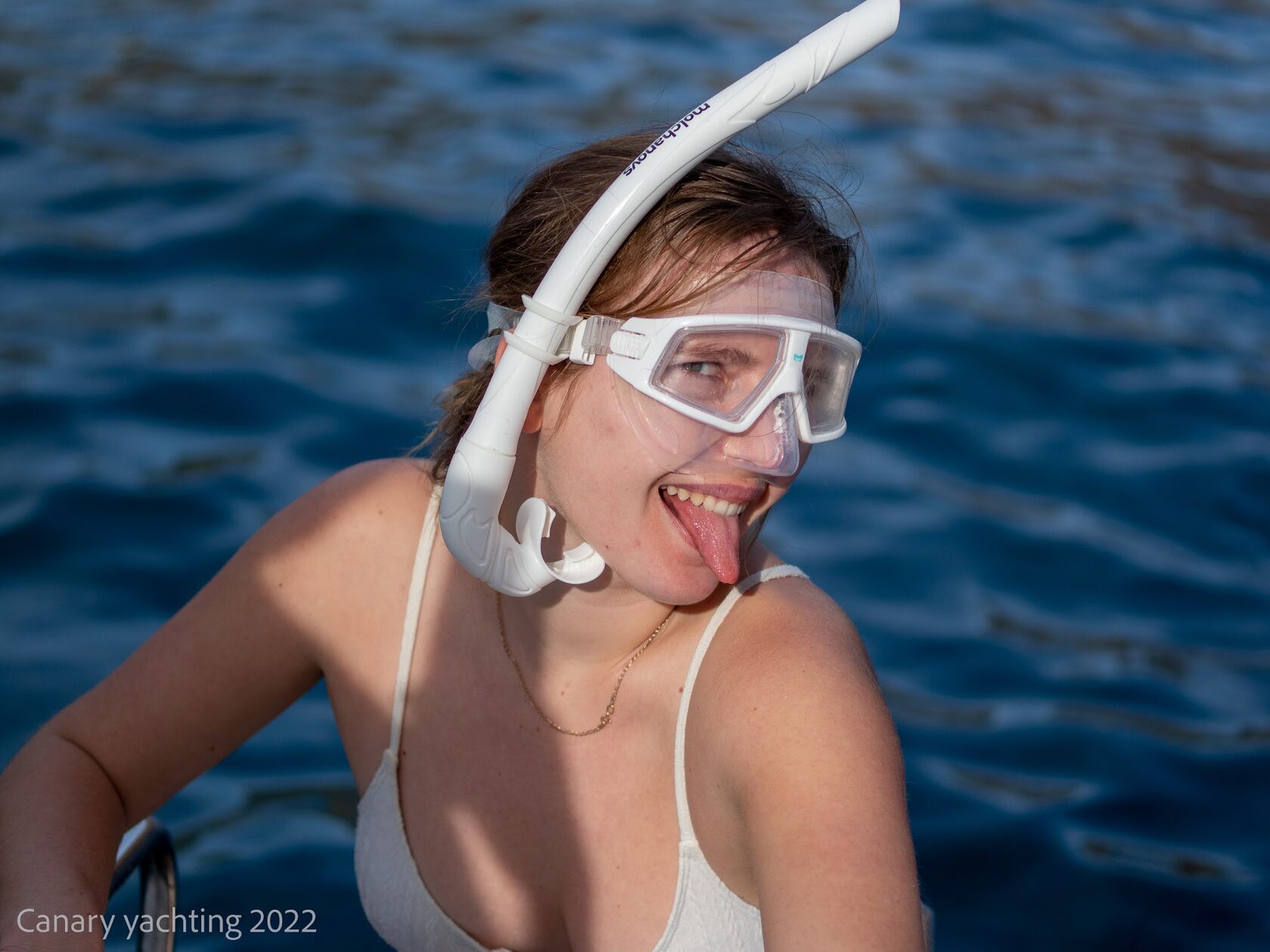
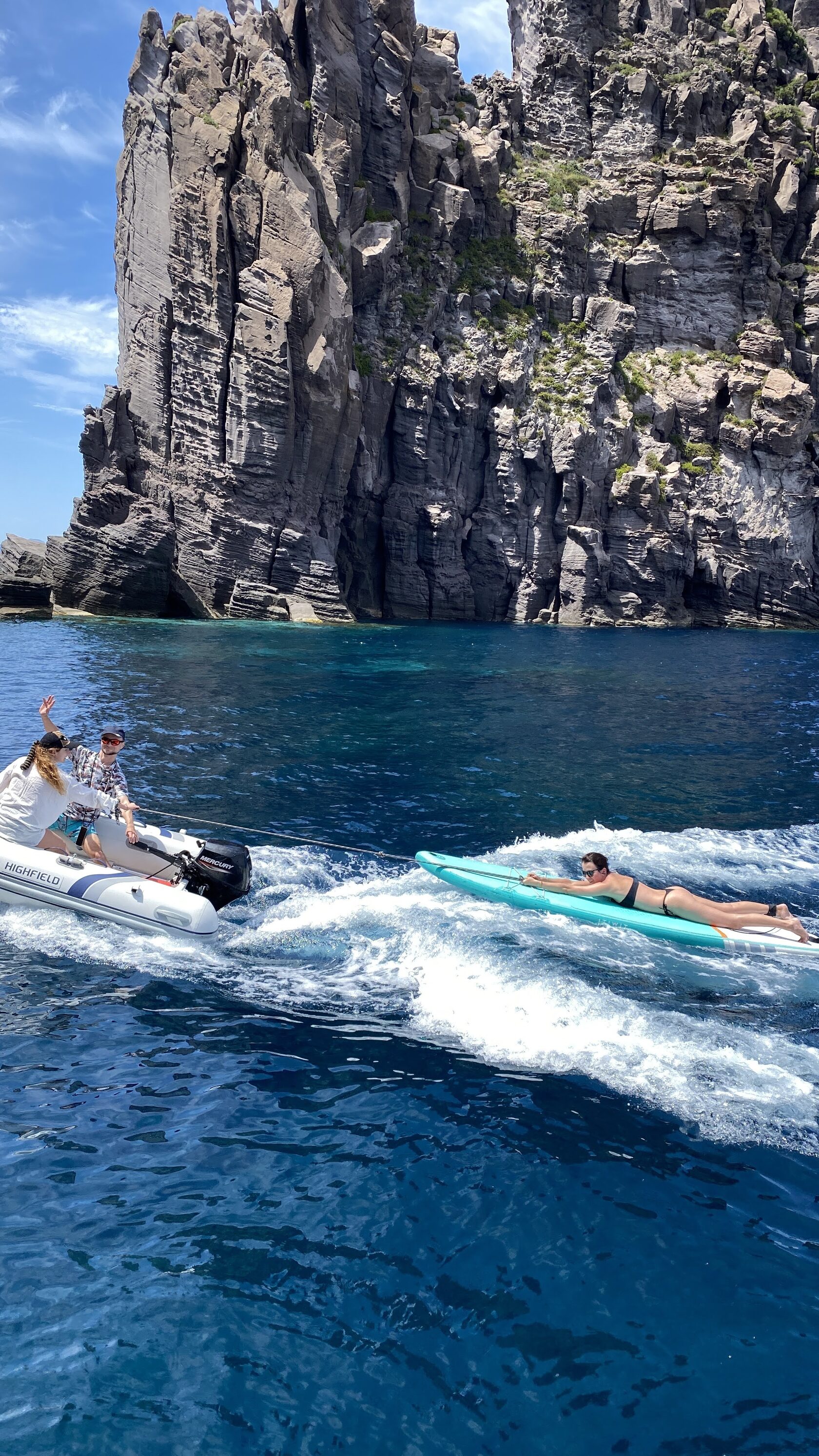
And it’s all about fun, not just technical passages. Whenever we’re in a bay, we pump up the SUP board, drop the dinghy, our small rubber motorboat, and have fun around. The ocean water is warm. Of course it’s colder than the Mediterranean in the middle of August, but it’s still comfortable, and we swim pretty much every day. There’s also a chance to walk around Canarian towns every day.
Here’s the picture I wanted to show you about the weather. At some point you may want a jacket, but later the same day you’ll want to be in your bikini or swimming shorts, because it can be warm or even hot. You don’t need special equipment. The picture on the left is a typical light ski jacket or rain jacket from any tourist shop. You can also use a rain layer that costs about €20 on top of your fleece or any other jacket. It’s still warm-water sailing, and there will be chances to swim and even sunbathe.
19:12 Do you need experience? The optional Competent Crew license
You don’t have to be an experienced sailor. I recommend a little experience so you’re as comfortable as possible in the ocean, but technically you don’t need it. If you’re mentally ready, you’re ready for Canarian sailing.
If you’re keen to learn, at the end of the week you can optionally get a Competent Crew license, because we’re a school accredited by ISSA. You learn a few things, like some sea knots, how to help with manoeuvres and docking, and how to work with the sails. It’s a minimum set of skills, no hard work at all, and it entitles you to a yacht crew license. That license gives you priority over unlicensed candidates for more technical trips or expeditions, or if you want to cross an ocean later in your life.
20:40 Waves, seasickness and safety
Now I want to be completely honest and open about the ocean. Simply put, the ocean is not a joke. You need to be mentally ready for wind and waves. We can get a lot of wind, and the waves can get high in some areas between the islands, sometimes for two or three hours at a time, so it can be physically challenging. The good news is that you don’t need to go to the gym. It’s more about mental readiness for the challenge, because physically there’s no hard work. Just be ready that sometimes it will feel like we’re jumping on the waves.
Seasickness is a fact. Some people say they get seasick and some say they don’t, but my experience shows that anyone can get seasick, especially in the ocean. Luckily, if it happens, we know how to stop it, so it’s not a problem, just a fact we can work with. There are simple tips like watching the horizon or keeping a piece of ginger in your mouth, and you can also take a pill that removes the symptoms. There’s no point coming sailing to suffer from seasickness, so everybody will be enjoying it.
Now, safety. Every skipper, including me, is all about safety. We’re trained to use all the safety equipment and devices. Most importantly, all the yachts we use are ocean class: designed and equipped to cross any ocean on the planet. You can expect an automatic life raft, satellite beacons and, of course, the traditional things like a radio, life jackets and a dinghy. We always have all that on board. If the weather becomes rough for any reason, we know it in advance and change the route, not to fight the weather but to respect it. We go to a different island, where the wind and waves are our friends, not our enemies.
As for fitness, you don’t need to be especially fit. If you can walk and jog a little, that’s it. Hiking is optional too, so you can hike as much as your abilities allow. You don’t need to climb cliffs or anything like that. Instead of hiking up a mountain, you can enjoy snorkelling or sunbathing.
24:42 Who’s on board and how cabins work
I often get the question: who are all those people on board? A typical team is 8 to 10 people including the skipper, typically aged between 30 and 50. There may be exceptions, but that’s typical. Both men and women: I always do my best to get close to 50/50, though of course it’s not always exactly 50/50. An interesting fact is that about 80% come alone. Couples are welcome, of course, and some people bring a friend, but the majority come alone. Everyone speaks English, which is mandatory for our trips, and we all come from different countries: mostly Europeans, and sometimes people fly over from the Americas.
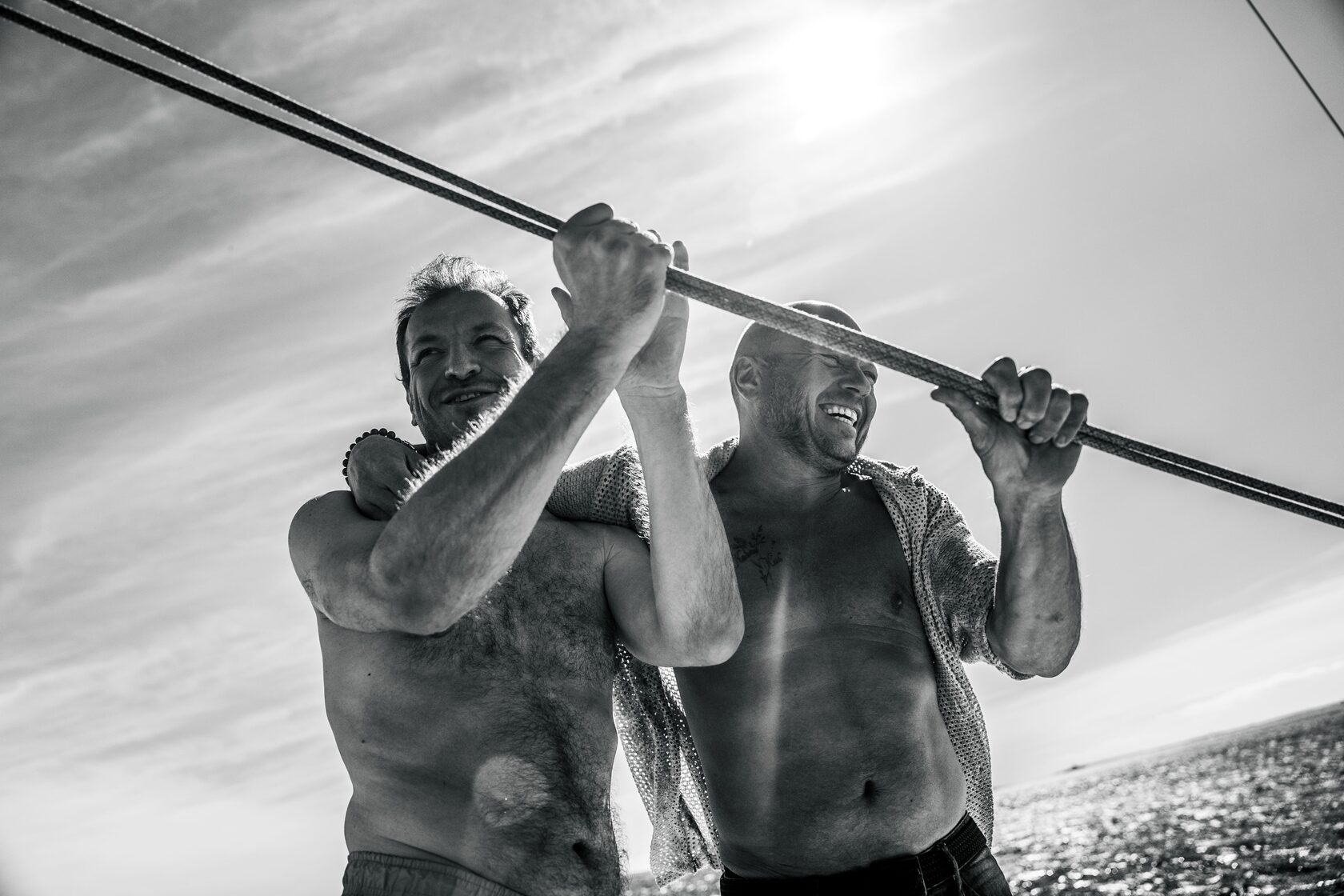
The main philosophy of our trips is that there are no passengers on board and no hired staff doing jobs around us. That’s why it feels so special, relaxed and welcoming: it’s just our team of sailors and the yacht. No one is walking around watching us, and we feel complete freedom. You become a crew member and share some responsibilities, like sometimes cooking a meal or tidying up after eating. Imagine a group of eight strangers turning, in a couple of days, into a group of close friends, sometimes even something like a family. By the end of the trip it’s really difficult to say goodbye, and people always ask whether it’s possible to extend the trip.
A lot of people ask how we sleep. Most cabins are doubles, and sometimes there are bunks. You can share a cabin, which a lot of people like; that’s the basic spot. Some people upgrade to a whole cabin for a supplement, to maximise their private space and comfort. Usually we share by gender, with ladies’ cabins and gents’ cabins, but it’s all by agreement.
28:21 Invite-only trips and the pre-trip call
The most important thing is that our trips are invite-only. You can’t book online on the website. Only candidates who have had an individual pre-trip call with us can be invited, once we know each other and understand each other’s motivation, wishes, background and values, and we match. For me, that’s our unique and most important value. We invest a lot of time in talking to absolutely all candidates; sometimes I’ve had six calls a day, and I don’t mind, because I love talking about sailing. It means we have the best possible, pre-selected people on board, and no random people. I still don’t understand how other organisers allow online booking: people may come with completely different or wrong expectations, they can’t enjoy the trip, and that’s not a good environment for the others either.
29:49 Guest stories: Sue and Reuben
Sergy: Now we have Sue and Reuben, who have both sailed with us before. Sue, can you hear me?
Sue: Yes, I can hear you perfectly. Can you hear me?
Sergy: Yes, hi! Nice to see you. Which trip did you sail with us?
Sue: My first trip with you was in Thailand, which was super exciting. That was over a year ago already, in 2024 I think.
Sergy: Thanks for agreeing to share and to be visible on this webinar. I remember you came on your own, like 80% of our guests. How did it feel on the first evening, surrounded by seven strangers? What kind of dynamics did you experience?
Sue: It was like an adventure. Everyone was so excited to be on board, with varying degrees of sailing experience. We only had one boat on that trip; I think it was your first trip in Thailand. The big thing that stuck in my mind is that before we all went out for dinner, you sat us all down and we got to know each other. You helped the group gel and talk about how we were going to live the week on the boat. I particularly remember you saying that this is our week, and it’s what we make of it. That was very true, and it got the whole trip off to a very nice start.
Sergy: Thanks for noticing those little things, like the introduction circle, and that you become a co-creator of the trip. It’s your boat, not my boat with you as a passenger. What surprised you the most during the week?
Sue: It was my first experience of sailing with a group. I’d done lots of sailing before, but mainly with friends and family. Thailand itself was really interesting and spectacular: a great place to sail around and explore, with lots to do like hiking and caves, and the food was amazing. We went from desert islands to bigger towns and sometimes resorts. It was quite magical how everybody just got on with everything. Some people love to cook, so they naturally took over the cooking, and we had really enjoyable conversations with interesting people. That’s what I love about it, and that’s why I’m here in Ibiza doing it again. It’s like a big networking group of like-minded people, and I find that really great.
Sergy: Thanks so much. You’re in Ibiza already, aren’t you? I’m coming in three days to start our big trip, and I’m so glad you’ll be sailing with us again. One last thing: when you booked the first time, what do you wish you’d known before booking?
Sue: Having spoken with you, I was very confident and happy to come along. If I hadn’t sailed before it might have been slightly different, but I could tell I was in very good hands. A lot of organisation goes into these trips, and I appreciate that. Everything runs really smoothly, so you can relax. Your experience and attention to detail make it a good experience for everyone. If anybody’s a little bit cautious: I love sailing. It’s absolute freedom and a joy, and once you experience it, it’s slightly addictive. That’s why so many people come back. The only thing I’d say is that it’s slightly dangerous for the bank balance!
Sergy: We’ll talk about the bank in a few minutes. Thanks a lot, Sue, see you soon. Now we also have Reuben. Reuben, can you hear me?
Reuben: Yes, I can.
Sergy: Which trip did you join the first time you sailed with us?
Reuben: The first time was in Sardinia last year, in 2025, and the second trip was three weeks ago in Sicily.
Sergy: Yes, this summer we did Work and Sail. Thanks for joining. A couple of questions: do you remember how much you actually sailed? Did you steer the yacht or watch the passage? What was your objective, and was it fulfilled?
Reuben: I like to participate in the sailing, so I naturally took the opportunity whenever it was there. On an average day we’d sail maybe three or four hours, but it really depends. Sometimes I helped raise the sails or drop the anchor, which doesn’t take much time, and sometimes I was steering and navigating. Especially in the north of Sardinia, there are some narrower areas with more traffic, where navigating takes more attention.
Sergy: So it sounds like you sailed as much as you wanted. Perfect, that’s the idea. As we said, we go ashore pretty much every day. What did you do ashore?
Reuben: It depends on the area. There’s always swimming, if you want to. Once we stayed for a very proper lunch that took the whole afternoon. Another time we took the SUP board or the dinghy to a very nice, large beach in Sardinia. Also some short hikes, up to an hour or so. Some people decided to hike, some to swim, some to stay on board. It’s really up to you to decide what you like, without feeling pressure to join a group. That’s what I like most: once you’re anchored in a bay, you just do what you feel like.
Sergy: Yes, I remember we often had subgroups: one hiking, one shopping for souvenirs or fresh clothes, and one staying on board doing nothing, which also makes sense, because it’s a holiday after all. Last tricky question: what would you pack that most people don’t think about?
Reuben: If you want to help with the sails, definitely sailing gloves. Hoisting the sails can be really challenging, so you really want gloves.
Sergy: Thanks for the advice. And to close: if people watching aren’t sure about their first trip, what advice would you give them?
Reuben: My advice is to step into a call with you and raise your concerns. Any concern or question I had, or anything I didn’t know about how it worked, we cleared up in a call, and that made me confident to say yes, I want to do this trip. It has probably been one of my best holidays, out there on the sea.
Sergy: Thanks so much for your warm feedback, Reuben. I hope to see you again sometime.
42:26 Dates and what’s included
Sergy: Now I’m back to the presentation. There are two possible dates for this Canary Islands ocean adventure: 12 to 19 December, and 6 to 13 February. In February we’ll also have at least one more yacht or catamaran for singles, so it’s the ocean adventure plus more like-minded people if you’d like to be surrounded by other singles. There we take even more care about gender balance, and the singles may also sail on a catamaran, while our Canary Islands adventures are normally on a sailing yacht. If you’re not sure what the difference between a catamaran and a yacht means, no problem: you can clarify all your questions on a call with me.
What’s included: seven days and seven nights living and sailing on the yacht, always with a licensed captain, me or one of my colleagues, yacht insurance, cabins equipped with bed linen and towels, all the activities, and a motorboat for exploring wild bays.
[The prices and the webinar-only promo code mentioned in the live session have expired. See the trip page for current prices.]
To give you the full picture of costs, with no surprises or hidden costs: you sort out your own flights or other transport to Tenerife. Food, drinks, fuel and marina fees are shared by the whole team, roughly 180 to 240 per person for the whole week. You don’t pay this money to anyone; it’s your own spending during the week, classic sailing expenses, and there’s no fixed amount because it’s only what you actually spend. There’s a refundable security deposit of 250, which you get back at the end of the week. And if you go for the Competent Crew license, printing and worldwide courier shipping cost 90, paid to the ISSA association. That’s optional, of course.
Here’s the link to book a call with me, the famous call we’ve mentioned a few times. You don’t have to decide or book tonight; in fact, you can’t book before we’ve had the call. It’s a no-obligation call to get to know each other and clarify details, including any questions, fears or uncertainties, because, let’s be honest, the ocean can be scary. We can discuss how confident you are in the water, and go through the safety and flotation devices if you’re not a strong swimmer. Spoiler: you don’t have to be a good swimmer to become a good sailor.
48:04 Live Q&A: Wi-Fi, daily rhythm, wind limits, shoes
Now, questions and answers. If you’re watching on YouTube, thanks for all the comments; I was able to look at them from time to time. Feel free to type your questions in the chat. I know there’s a delay, so I’m happy to wait.
First question: do we have Wi-Fi in the Canary Islands? Yes. We already have three yachts, because some will go on the school programme and some on the adventure programme, so whether there’s a router will depend on the yacht. But the important thing is that Wi-Fi on a yacht runs on the phone signal: the same 3G, 4G or 5G internet from a SIM card, whether it’s from your phone or a router. Luckily, 80 to 90% of the time we’re connected, because we’re not too far out in the ocean.
Another question: what time does life on the boat start in the morning? Some people wake up at 7 or at sunrise, which can be around 6:30 or 7 depending on the place and season. Early risers are usually quiet, with a cup of tea or coffee, meditating or reading a book. Breakfast is normally between 8:30 and 9. If you want to sleep until lunch, that’s okay too; you can skip breakfast. In the evening, the activities, chats, dinner and music typically finish by midnight, because we want good sleep and an early start the next day. But it can be different: if the whole team wants a spontaneous party with dancing or singing, why not? Remember, the most important thing is that we’re free.
Next: up to what wind and wave conditions is it possible to reach La Palma comfortably? Really nice question. First, it depends on the wind direction. My main principle is that all winds up to 30 knots are quite comfortable for us adrenaline sailors. I’m not talking about old sea wolves, who can sail even in a hurricane. Above that, we can still go by engine. But if the waves are too high and we’re going against them, we change the route. With a headwind of more than 20 to 25 knots, we wouldn’t go to La Palma, because it wouldn’t be comfortable: it would be like 3-metre waves against us. When 3-metre waves are going with you, it’s a totally different story, and very pleasurable sailing.
And the last question: what kind of shoes do we need if it gets slippery on the boat? Good news: the boat is specially designed not to be slippery. Inside it can get slippery when wet, so we keep the inside dry; outside it can be wet, and that’s okay because it isn’t slippery. Because we’re sailing in warm weather, you don’t need boots or professional sailing shoes. Normal sports or running shoes will do the job; just make sure the soles are clean before we start sailing. Because it’s warm, closed sport sandals are perfect, or even Crocs that close around the heel. But not flip-flops, because they don’t protect you at all.
54:00 Other trips and staying in touch
As promised, we have a lot of other trips. If the Canary Islands aren’t for you but you’re still curious, you can go to paradise: this winter we’re sailing the Seychelles on a very comfortable catamaran, and we’re also going to the Caribbean, to the British Virgin Islands. Those two places are pure paradise on earth, full of palm trees, coconuts, pristine beaches, snorkelling, corals, turtles and sea life. Our trips aren’t only about rough sailing, but also about relaxation and paradise-like sailing. Have a look at the website to see what we have. We also have flotillas, like the one that starts this Saturday: it’s like a little festival, with more than five yachts sailing together.
Don’t forget to follow us. Maybe you’re not ready yet, so on Instagram find Elmár Sailing for more practical information, and my personal blog to see what our trips look like from the inside, including some funny moments. Feel free to join the sailing WhatsApp group, where I’ll post updates and offers from time to time.
That’s it. Thank you very much. I hope you enjoyed it, and I hope I’ll see you on board. Sailing isn’t for everyone, but let’s see; maybe it’s for you. Have a great night. Bye-bye.
A real sailing adventure
Built for people who want to feel the wind
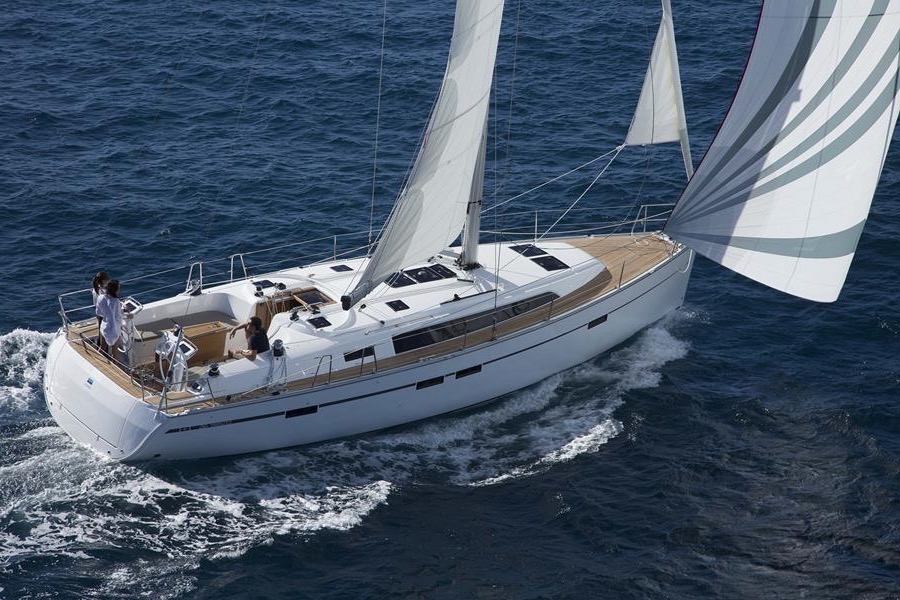
A week for adventure seekers: sails up on passages between the islands and the helm yours whenever you want it. Ashore there are volcanic trails, swims in bays only a yacht can reach and dinners at sunset, so it’s still very much a holiday.
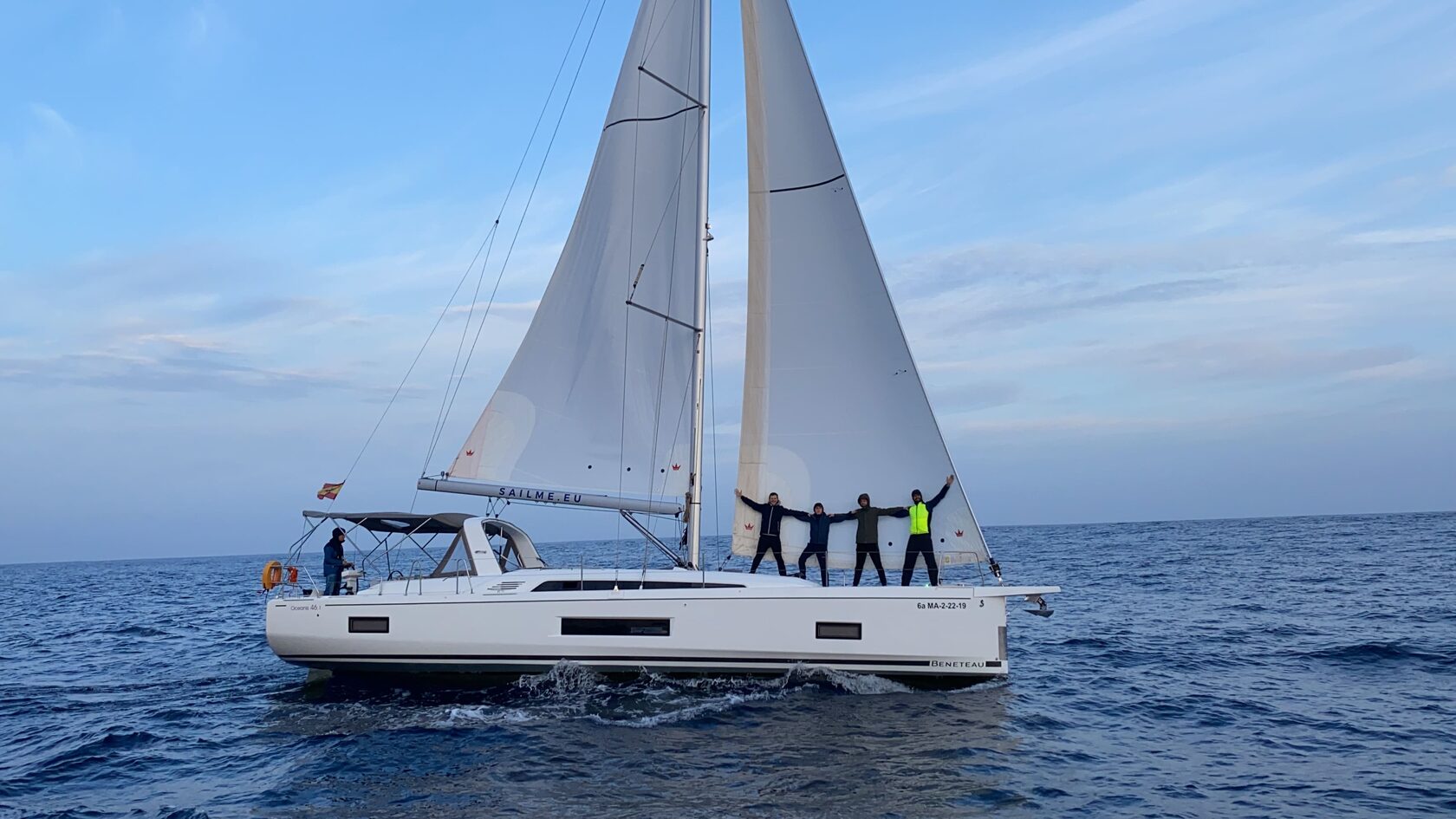
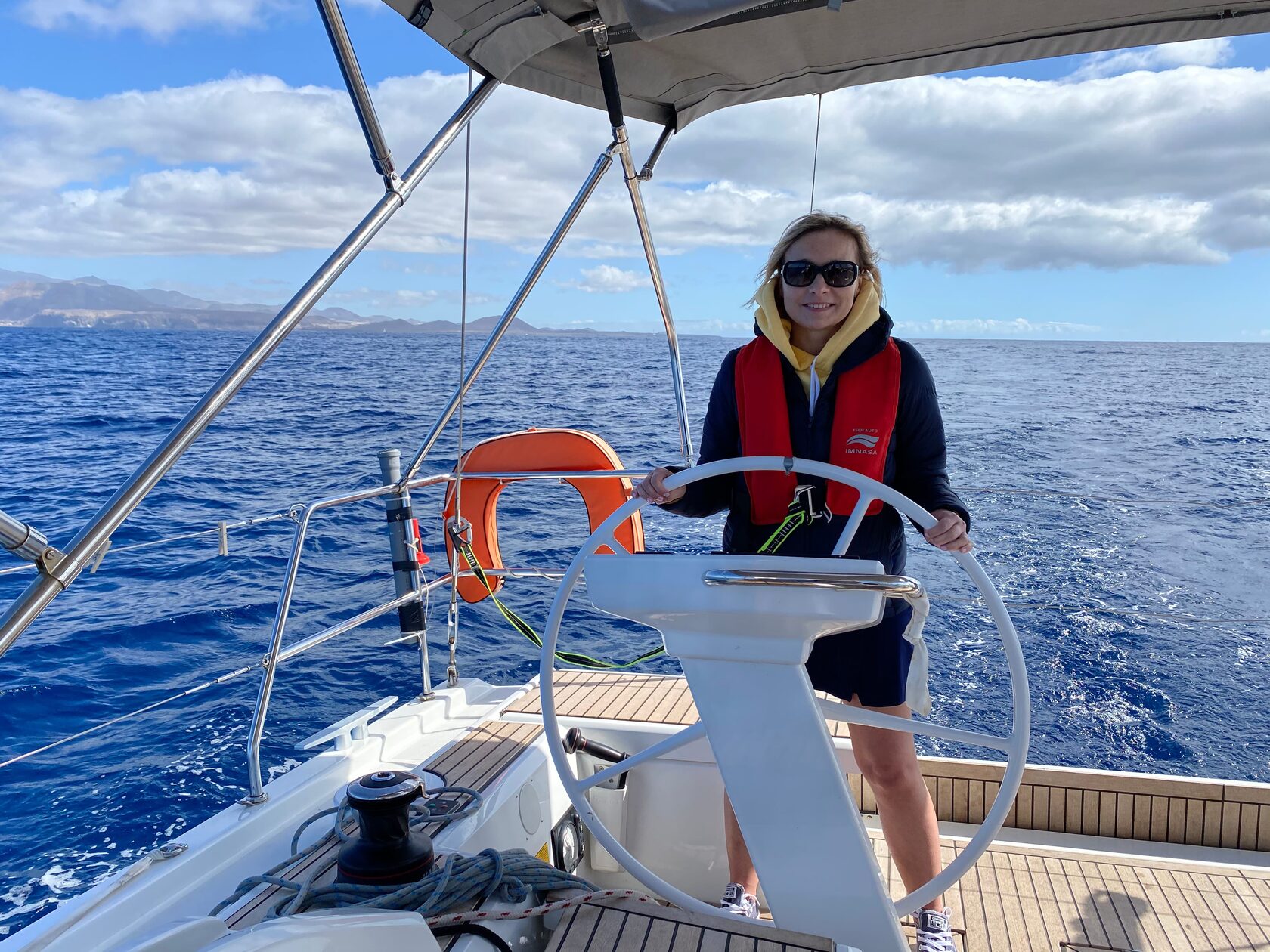
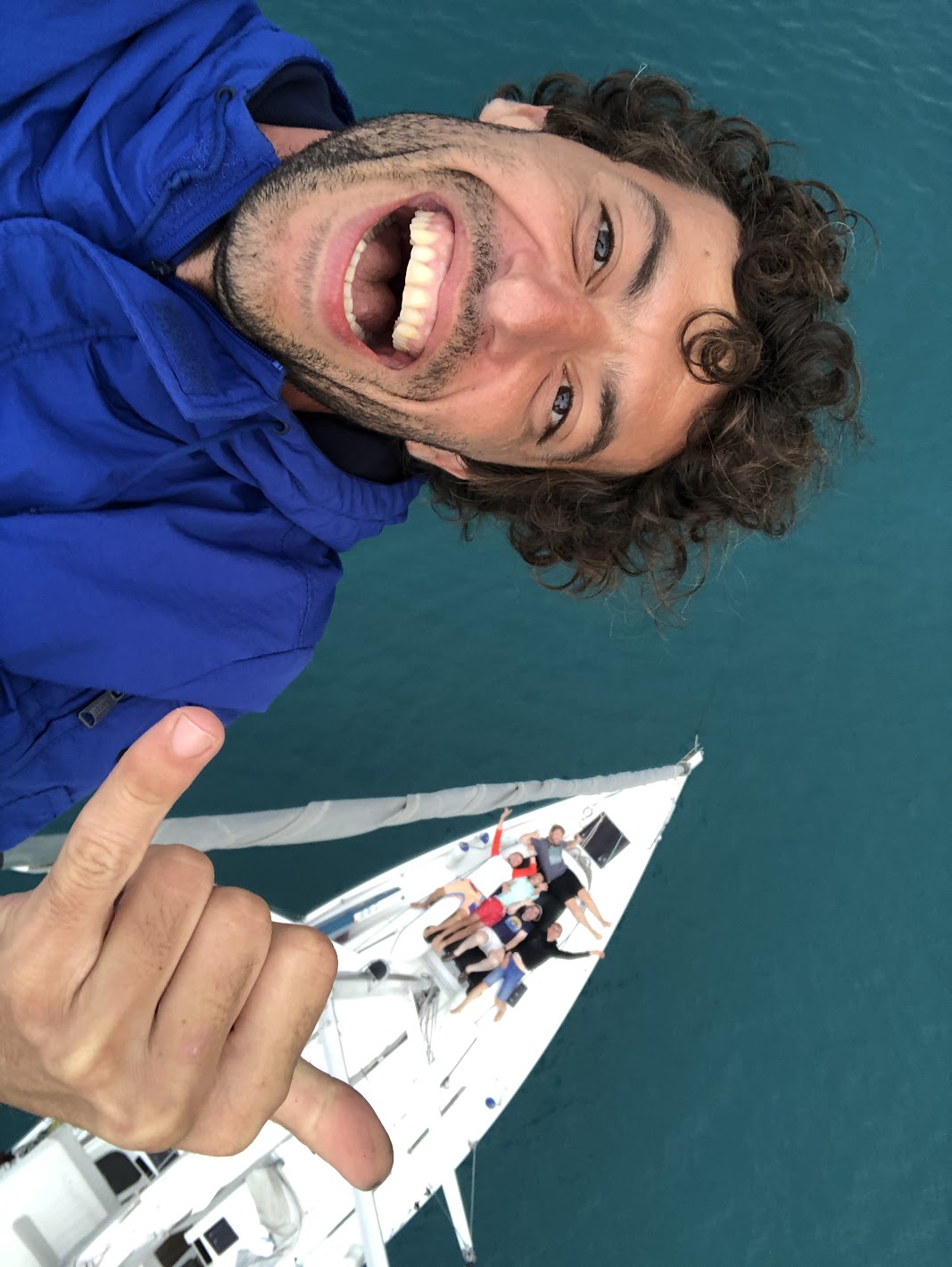
What the week feels like
Moments from our sailing weeks

What’s in the recording: tap a time to jump there
An honest walk through the week, then guests’ questions
- 3:28
Who’s your captain
From a career in IT to more than 25,000 nautical miles, and what Elmár Sailing is.
- 5:23
Why the Canary Islands
Wind and waves are guaranteed, so you sail instead of motoring through a flat Mediterranean summer.
- 7:44
How the week works
You live on the yacht, explore ashore about half the time, and shop and cook together. Nights are in marinas or at anchor.
- 10:52
The route
Start and finish on Tenerife, then La Gomera and, if the wind allows, La Palma.
- 14:41
A day on board
Coffee in a bay, sailing between islands, learning to helm if you want, then swims and paddleboarding.
- 20:40
Waves, seasickness and safety
An honest talk about ocean conditions, how seasickness is handled, and the ocean-class safety equipment.
- 24:42
Who’s on board
8 to 10 people, mostly aged 30 to 50, about 80% come alone, and how cabins are shared.
- 29:49
Guest stories
Sue and Reuben on joining alone, how much they sailed, and what to pack.
- 42:26
Dates and what’s included
What the price covers and the shared costs to budget for.
- 48:04
Live Q&A
Wi-Fi on board, the daily rhythm, wind limits for La Palma, and which shoes to bring.
Who this week is for
Adventure by day, a proper holiday all week
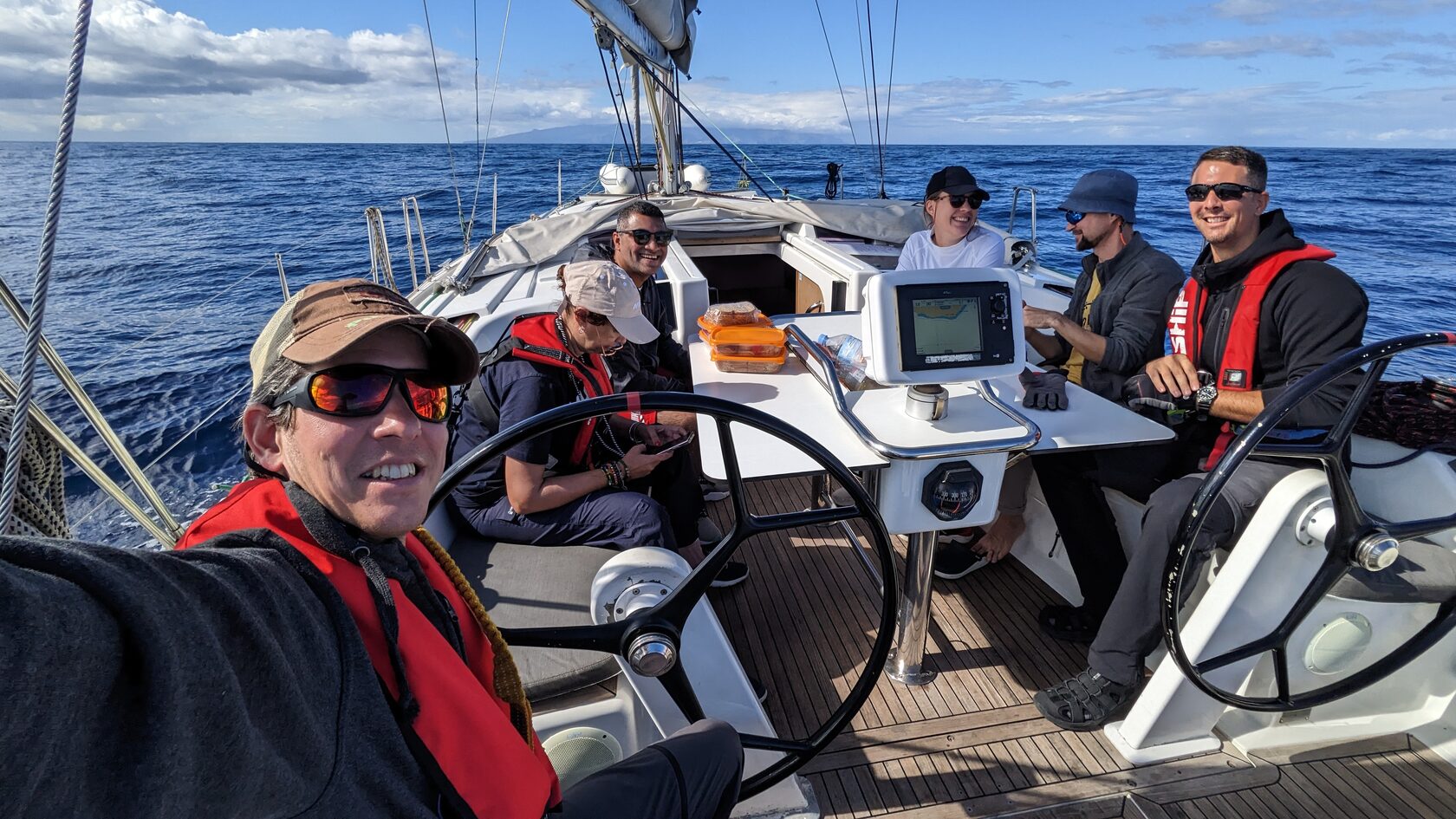
Sailors who want more time at the helm
You’ve sailed before, maybe you hold a license, and you’re after real passages, proper points of sail and a captain who hands you the wheel.
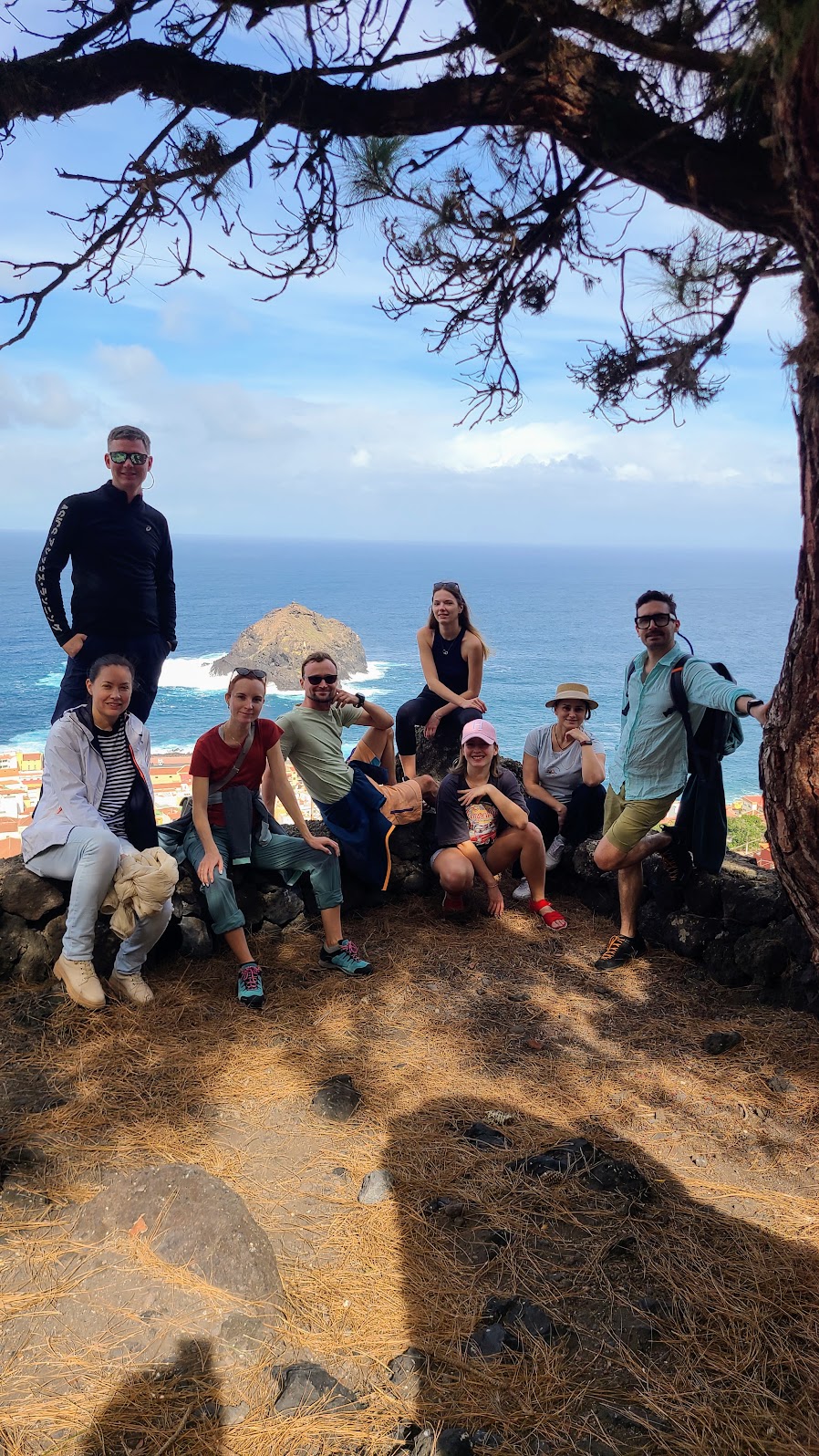
Active travellers
You like to move on holiday, so hiking, swimming and exploring on land matter as much to you as the sailing, and so do the lazy hours in between.
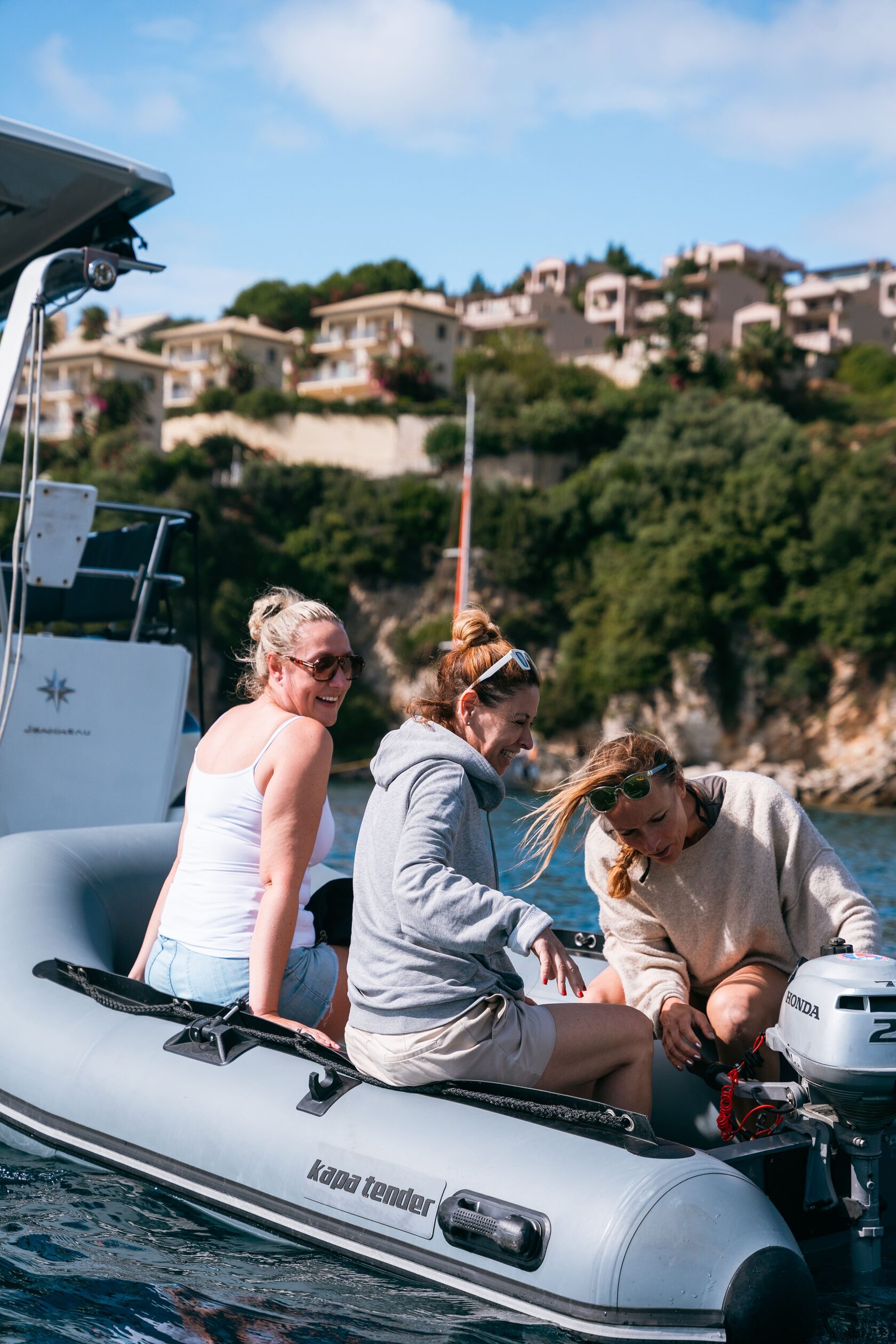
Curious beginners
No experience needed. You want to learn real sailing at your own pace with lessons on board, and maybe leave with a license.
license
Want a sailing license out of the same week?
The Competent Crew course runs on the same dates, 12–19 December 2026, with the ISSA Competent Crew license included. It’s optional: learn the skills properly, or simply enjoy the sailing.
From guests who sailed with us
Real wind, real adventure
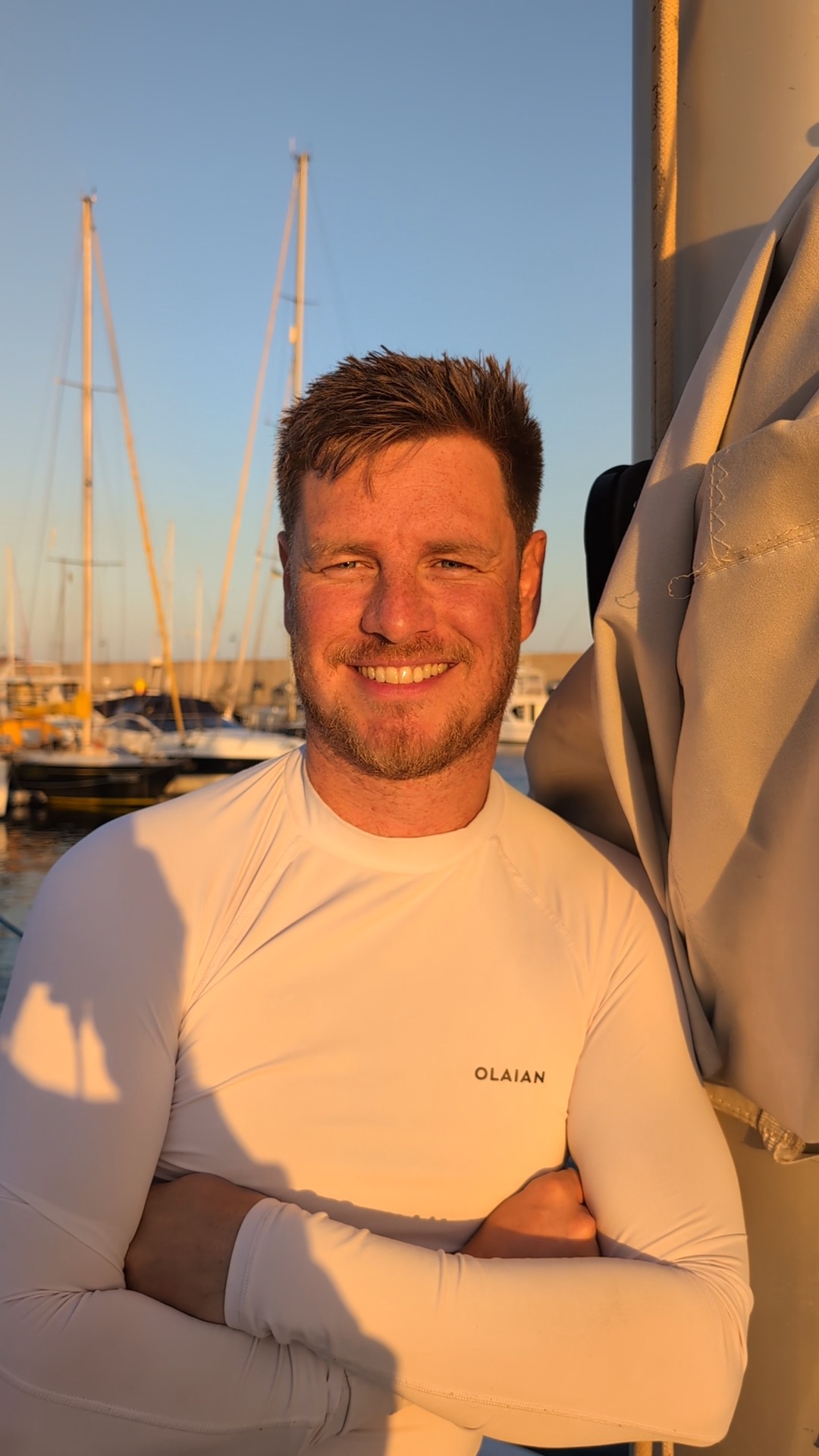
“It was challenging but I felt safe, basically always.”
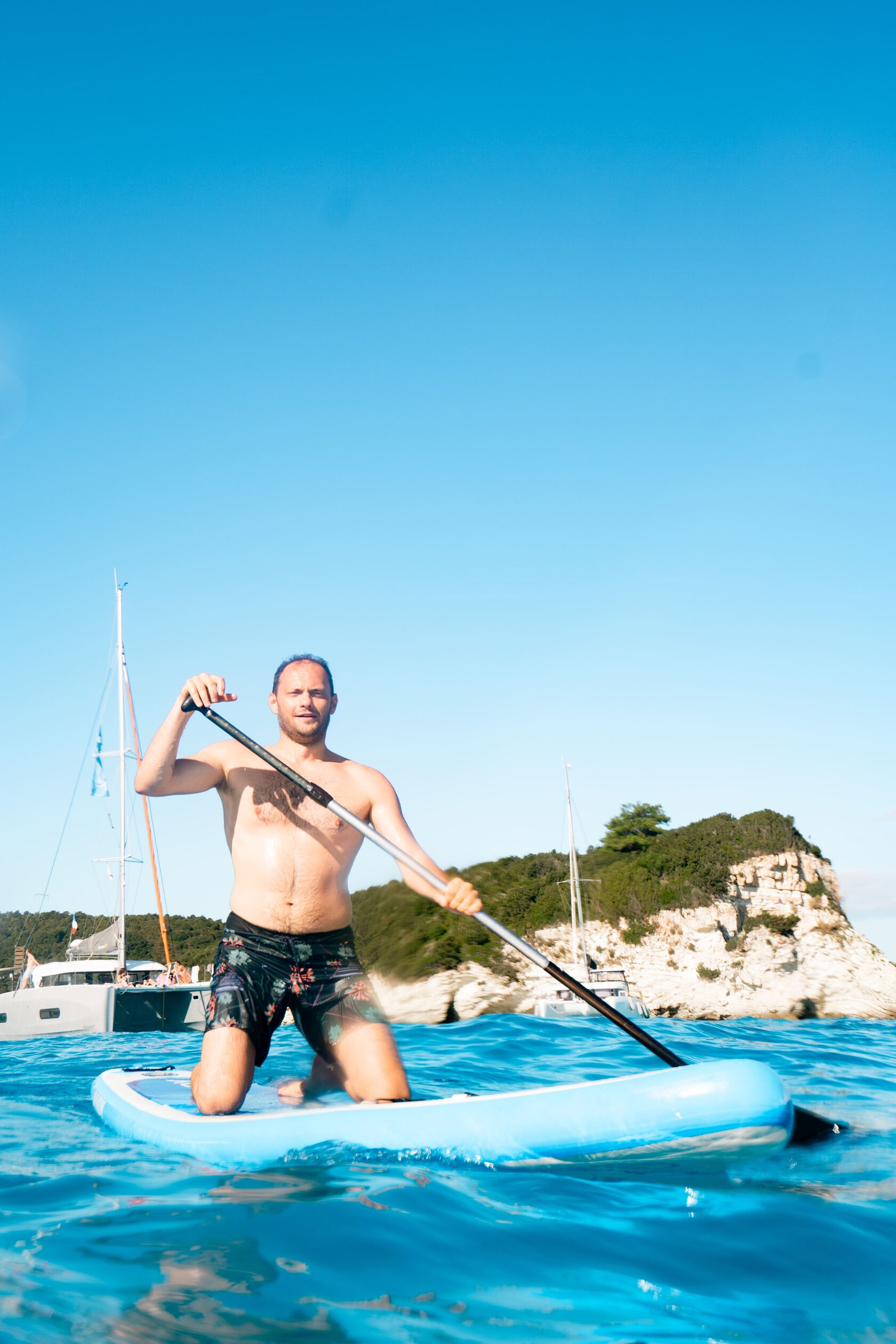
“We had amazing sail time, we went up to 8 knots at one point. It was super nice, a little bumpy but cool.”
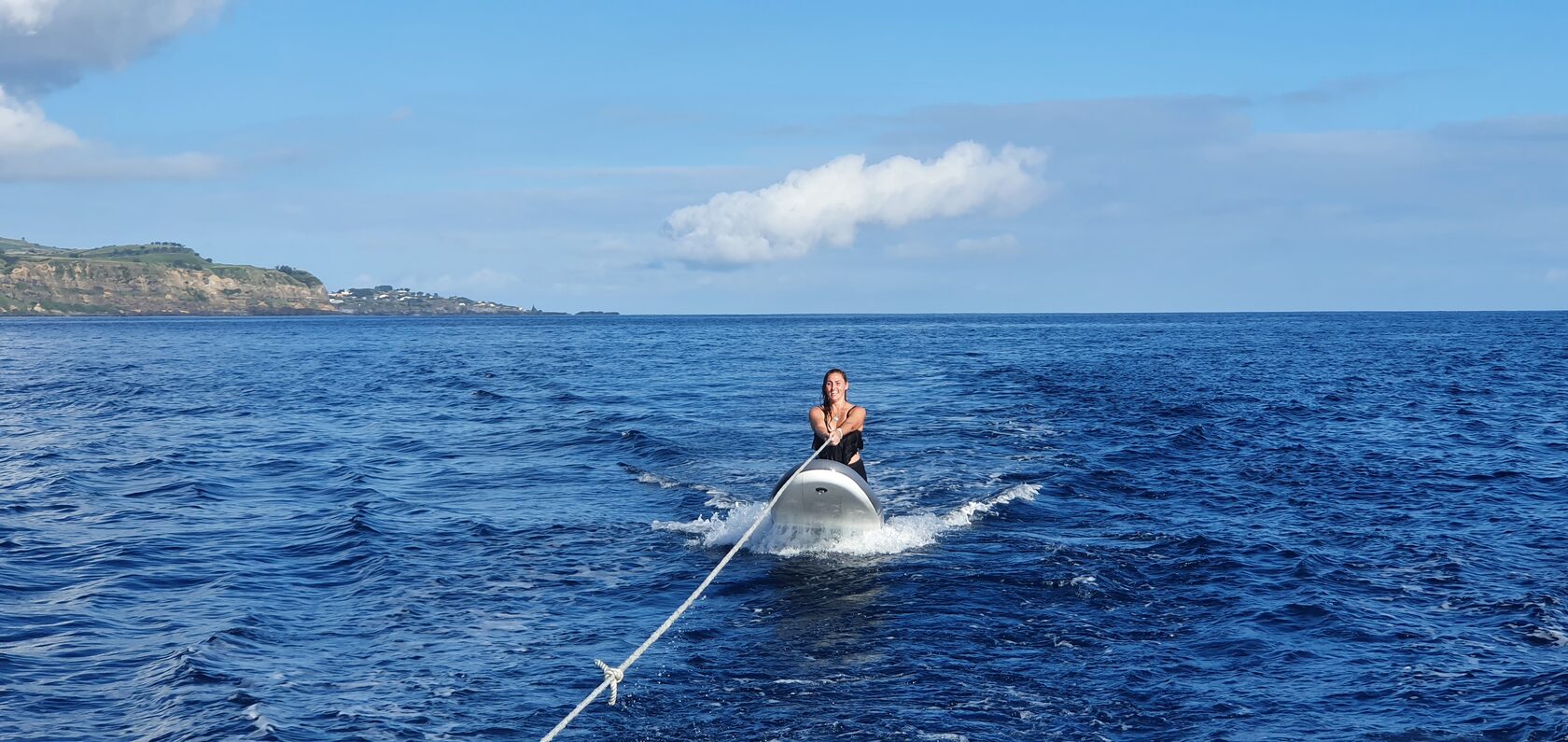
“It brings out the wild side and playing in the fullness of who you are.”
Your host
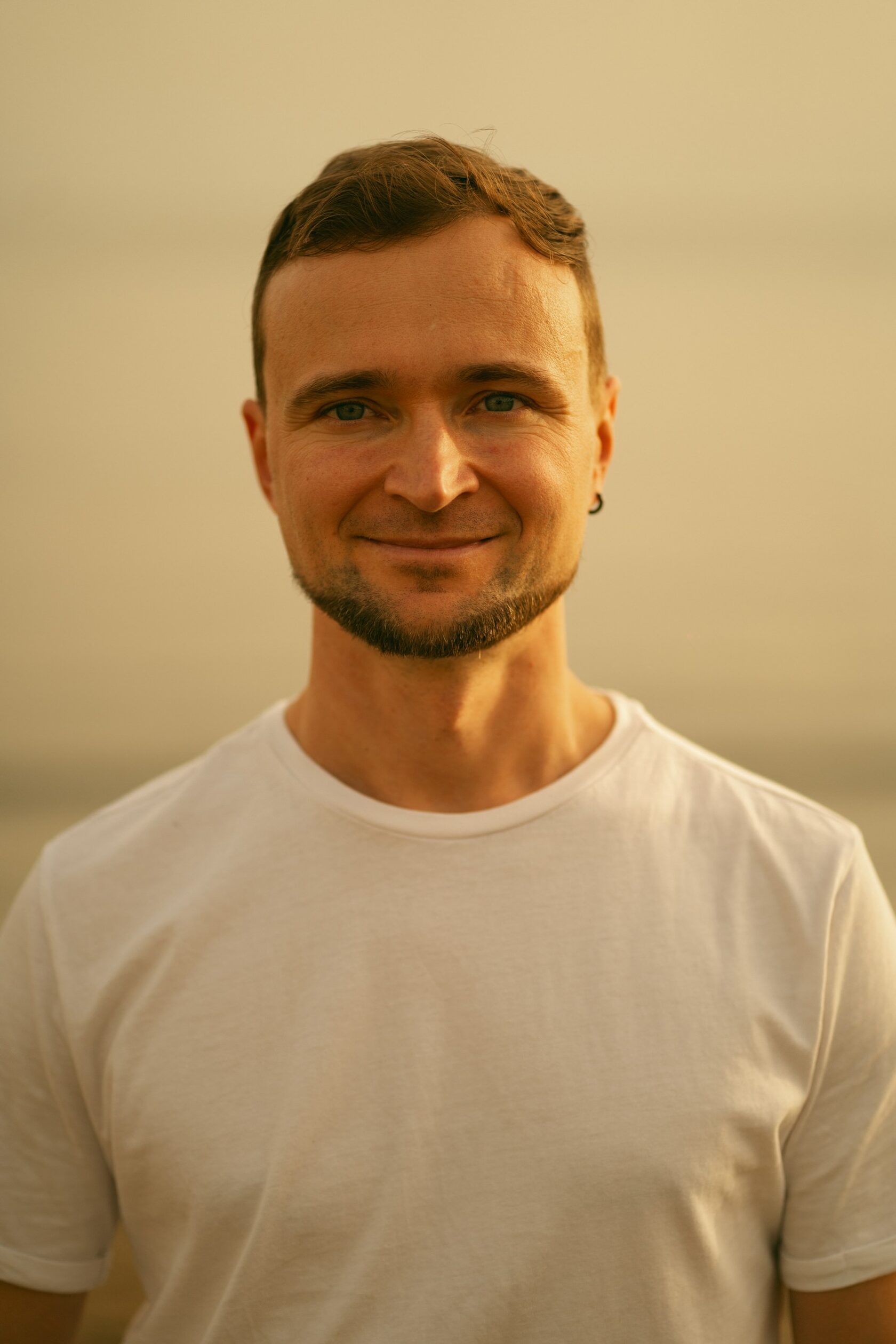
Captain Sergy Almer
Founder and main captain of Elmár Sailing. He left a career in IT for the helm, trained in Ireland’s harsh conditions, and has sailed 25,000+ nautical miles across Europe, Asia and the Americas as an RYA & ISSA licensed skipper.
He talks with every guest before a trip, so the group is the right fit before anyone sets sail. In this recording he answers the questions guests usually ask in that call.
- Trip
- Ocean Adventure Sailing
- Dates
- 12–19 December 2026
- Start & finish
- Tenerife
- Possible stops
- La Gomera, La Palma and more, depending on wind and weather
- Weather
- Warm: shorts, a wind jacket and swims
- Group
- Up to 8 guests, no experience needed
- Optional
- Competent Crew course with ISSA license, same dates
Questions about the week
Is the recording free?
Yes. Watch it right on this page, no registration needed.
Can a complete beginner go sailing in the Canary Islands?
Yes. About 80% of Elmár Sailing guests had never sailed before. Captain Sergy and his skippers teach on board at your pace, and navigation is always the captain’s responsibility. You need to be mentally ready for real wind and waves, but no experience or special fitness is required.
Is December a good time to sail in the Canary Islands?
Yes. Wind and waves are reliable, so you sail rather than motor, and it stays warm: the south of Tenerife can reach 30°C in December. Guests sail in shorts with a light jacket for windy days and swim almost every day.
Does the recording cover seasickness?
Yes, from 20:40. Anyone can get seasick in the ocean. Watching the horizon, ginger or a seasickness pill usually stops it, and the route changes when the weather would be uncomfortable.
Who else will be on board?
Typically 8 to 10 people including the skipper, mostly aged 30 to 50, both men and women. About 80% come alone, and everyone speaks English.
Is there Wi-Fi on the yacht?
Most of the time. Wi-Fi on board runs on mobile data, and around the Canary Islands you are connected about 80 to 90% of the time.
What should I pack?
Summer clothes, a light rain or ski jacket, and sports shoes with clean soles or closed sport sandals (no flip-flops). Sailing gloves help if you want to work the sails. No special sailing gear is needed.
Can I get a sailing license on a Canary Islands sailing holiday?
Yes, if you want one. The ISSA Competent Crew course runs on the same dates as Ocean Adventure Sailing, 12–19 December 2026, and is optional.
How do I book after watching?
Elmár Sailing trips are invite-only. Every guest has a no-obligation call with captain Sergy first, so the group is the right fit. Start from the Ocean Adventure Sailing trip page.
Free webinar recording
See the week before you decide on it
Fifty-six minutes with captain Sergy: the islands, a day on board, honest answers about the waves, and guests’ questions.
Watch the recording